Shallow Copy & Deep Copy in Python
By Hemanta Sundaray on 2021-08-30
Shallow copy
We will understand the concept of shallow copy and deep copy in Python using an example of the list data structure.
list_one = [1, [2, 3, 4], (5, 6, 7)]

list_two = list_one[:]

print(list_one == list_two)
# True

print(list_two is list_one)
# False
In the code example above. list_one[:] creates a new copy, to which we assign the label list_two.
Note that we can also create a copy using the
listconstructor:list_two = list(list_one).
Both the lists are equal (in terms of the values they hold), but refer to two different objects in memory.
Learn how to check the identity of objects in my blog post here.
Whenever we create a copy of a list (or any other mutable sequence in Python) using the list constructor (list) or slicing operation ([:]), we create a shallow copy. Hence, list_two is a shallow copy of list_one.
What does shallow copy mean?
It means that we have duplicated only the outermost container; however, the items inside the copy (list_two) refer to the same items held by the source list (list_one).
The following diagram represents the state of our program after we created a copy of list_one.
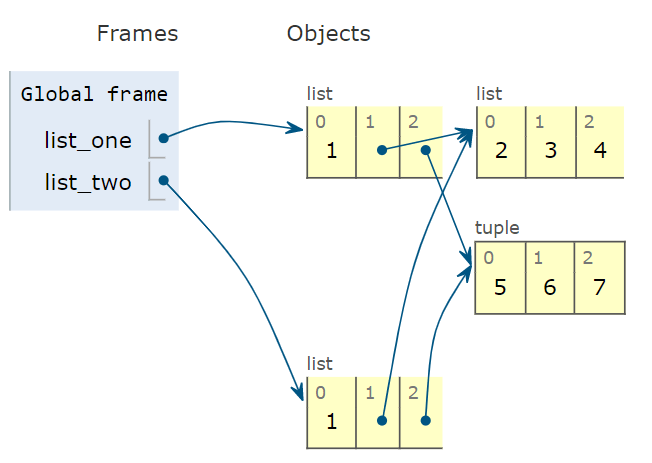
Notice how, the inner mutable sequences of list_two refer to the same inner mutable sequences held by list_one.
I created this visualization at
www.pythontutor.com. This site helps you visualize the changing state of your program as each line of code is executed. You must check it out.
Let’s add an item to the inner list of list_one and see whether that change is reflected in list_two.
list_one = [1, [2, 3, 4], (5, 6, 7)]

list_two = list_one[:]

list_one[1].append(8)

print(list_two)
# [1, [2, 3, 4, 8], (5, 6, 7)]
On line 5, we added 8 to the inner list (accessible via list_one[1]) of list_one.
Because list_two is a shallow copy of list_one, the inner list of list_two (accessible via list_two[1]) is bound to the inner list (accessible via list_one[1]) of list_one. Therefore the changes we made to the inner list of list_one is reflected in the inner list of list_two.
Keep in mind this concept of shallow copy in order to avoid nasty surprises in your program.
Deep copy
The next question is how can we create deep copies, copies that don’t share references of embedded objects?
We can take the help of the copy module that provides deepcopy and copy functions that return deep and shallow copies respectively of arbitrary objects.
Let’s again create a copy of list_one, this time however using the deepcopy function from the copy module.
from copy import copy, deepcopy

list_one = [1, [2, 3, 4], (5, 6, 7)]

list_two = deepcopy(list_one)

list_one[1].append(8)

print(list_two)
# [1, [2, 3, 4], (5, 6, 7)]
Notice that because we created a deep copy, the changes we made to the inner list of list_one was not reflected in list_two.