Create a Dropdown in React
By Hemanta Sundaray on 2021-07-06
Below, we have a Blog component that renders a dropdown.
import React, { useState, useEffect } from "react"
import axios from "axios"

const Blog = () => {
  const [blogId, setBlogId] = useState("")
  const [post, setPost] = useState([])

  useEffect(() => {
    ;(async () => {
      const { data } = await axios.get(
        `https://jsonplaceholder.typicode.com/posts/${blogId}`
      )
      setPost(data)
    })()
  }, [blogId])

  const handleBlogPostChange = event => {
    setBlogId(event.target.value)
  }

  return (
    <div className="m-5">
      <div className="mb-5">
        <label htmlFor="blog">Choose a blog post:</label>
        <select name="blog" id="blog" onChange={handleBlogPostChange}>
          <option value="1">Blog Post 1</option>
          <option value="2">Blog Post 2</option>
          <option value="3">Blog Post 3</option>
          <option value="4">Blog Post 4</option>
        </select>
      </div>

      <div className="card col-md-6">
        {post && <div className="card-body">{post.title}</div>}
      </div>
    </div>
  )
}

export default Blog
The resulting UI looks like this:
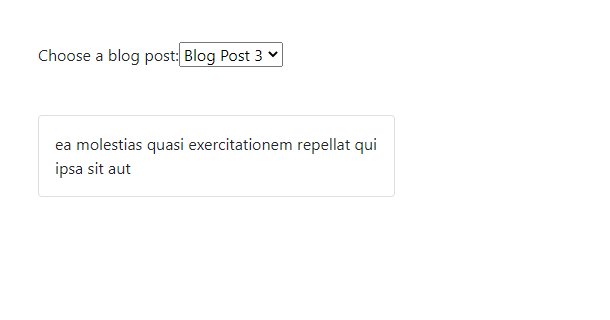
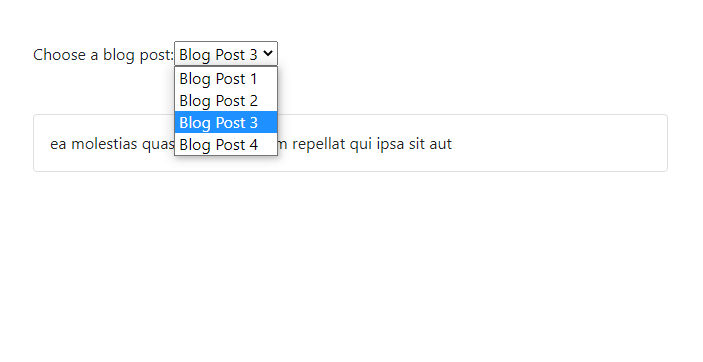
Every time we select a new option from the dropdown, handleBlogPostChange event listener is fired, which changes the value of the blogId state variable, which in turn runs useEffect (we have added the blogId variable to the dependency array), fetching the blog post whose id matches blogId.