A Beginner's Guide to Prototypes & Prototypal Inheritance in JavaScript
By Hemanta Sundaray on 2021-05-21
We know that in JavaScript, everything (except the primitive data types) is an object. An Object in an object. A function is an object. An array is an object. And so on.
Also in JavaScript, every object is linked to another object. That another object is called prototype. The linkage happens through an internal hidden property known as __proto__ (double underscore each side), which gets assigned to the object during its creation by default. The prototype also gets assigned to the __proto__ property by default.
More importantly, the created object inherits properties and methods from its prototype (aka prototypal inheritance). Also, every object in JavaScript has Object.prototype (an object that comes built-in with JavaScript) at the top of its prototype chain.
This all might sound gibberish to you. In order to make this a bit clearer, let’s look at some examples.
First off, we will create an object using the literal notation using curly braces. Note that you can also create an object using constructor notation using the new operator.
const person = {
  firstName: "Phillip",
  lastName: "Schofield",
}
Nothing fancy here. We have a simple person object which has two properties - firstName & lastName - defined inside it.
We can check whether a property is present in a specified object using the in operator. The in operator returns true if the specified property is defined in the specified object or its prototype chain.
Therefore, the following code returns true because the person object does have a firstName property.
"firstName" in person // trueNow, let’s consider another example.
What do you think the following code will return as its output?
“toString” in personAt first glance, you might say that the output will be false because the person object does not have a toString property. But lo and behold, we get true as our output.
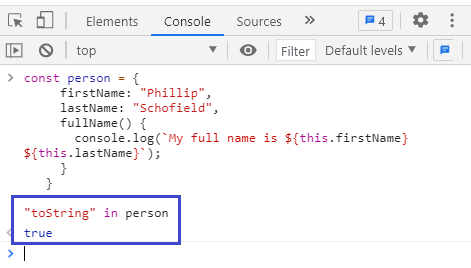
What the heck is happening here?
We have already said that an object inherits properties and methods from its prototype. And the object can find its prototype (which is also an object) through its internal __proto__ property (hidden).
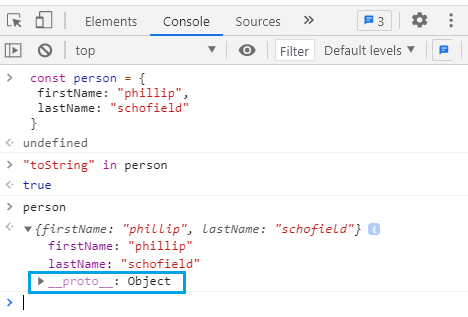
JavaScript does not find the toString property defined inside the person object. Therefore it moves up the prototype chain looking for the property and finds it defined inside the person object’s prototype, which in our case is Object.prototype - an object that sits at the top of the prototype chain (that is its prototype is null) and comes standard with JavaScript. This is the reason why the console logs in true as the output.
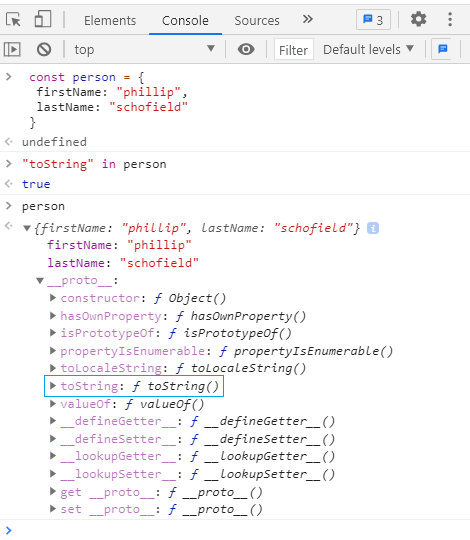
This was a simple example. We did not have any intermediate object that the person object inherited from. The person object inherited properties and methods directly from the Object.prototype object.
It is important to note that we can also assign our own prototype. Let’s do that by introducing another prototype object called person that other objects will inherit properties and methods from.
const person = {
  firstName: "Phillip",
  lastName: "Schofield",
  fullName() {
    console.log(`My full name is ${this.firstName}  ${this.lastName}`)
  },
}
Now, let’s create a child of the person object using Object.create() function, which is built-in JavaScript and is used to create children from a prototype object.
const personOne = Object.create(person)Here we have created a child object called personOne. Because children inherit the properties and methods from their prototype object, personOne has access to all the properties and methods from the person object. We can prove that by accessing the firstName property from the personOne object. As expected, we get Phillip as the output.
personOne.firstName // PhillipLet’s see what we get if we log personOne object to the console.
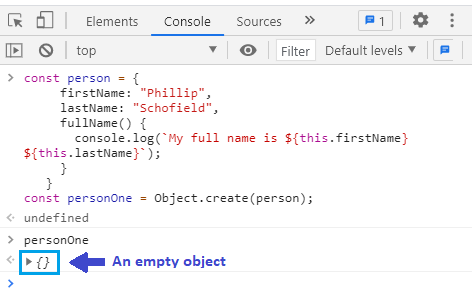
We get an empty object.
This is because we have not defined any properties and methods inside personOne object. However, personOne inherits properties and methods from its prototype object - the person object. As a result, personOne.firstName logs in Phillip to the console.
We can also override the inherited properties and methods and create personOne object’s own properties and methods. We can also create new properties and methods.
Let’s override the firstName & lastName properties using dot notation.
personOne.firstName = "Keira"
personOne.lastName = "Knightley"
Now personOne is no longer an empty object. It has its own firstName & lastName properties. If we log personOne.fullName() to the console, we get My full name is Keira Knightey.
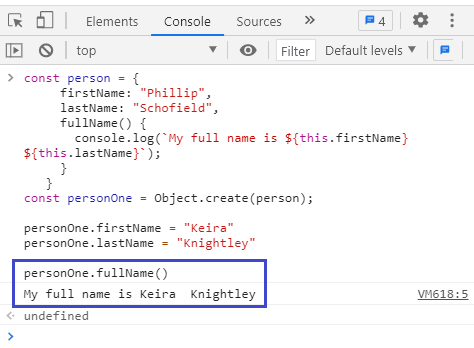
Now let’s delete the firstName property from the personOne object, after which personOne object is left with only the lastName property.
What do you think will be the output of personOne.fullName() ?
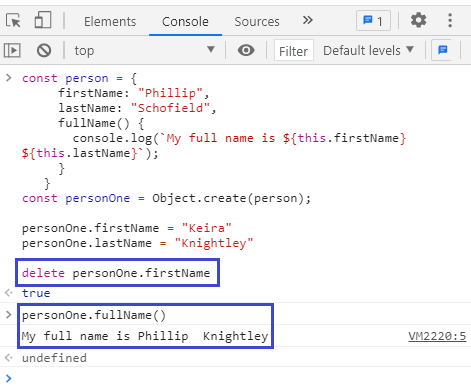
We get My full name is Phillip Knightley. Because, even though we had deleted the firstName property, personOne object inherited the firstName property from its prototype (the person object).
Another important concept to remember is that any changes made to the prototype object will reflect in the child object.
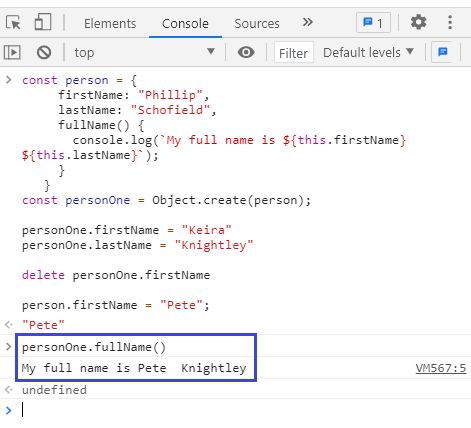
Let’s assign the firstName property inside the person object (the prototype object) a new value called Pete. This change is propagated to the child (personOne) object .
Now if we log personOne.fullName() to the console, we get My full name is Pete Knightley.
Hope you now have a basic understanding of prototypes and prototype-based inheritance in JavaScript.